
Room for Improvement: The No-Nonsense (But Actually Fun) Guide to Revenue Management Systems
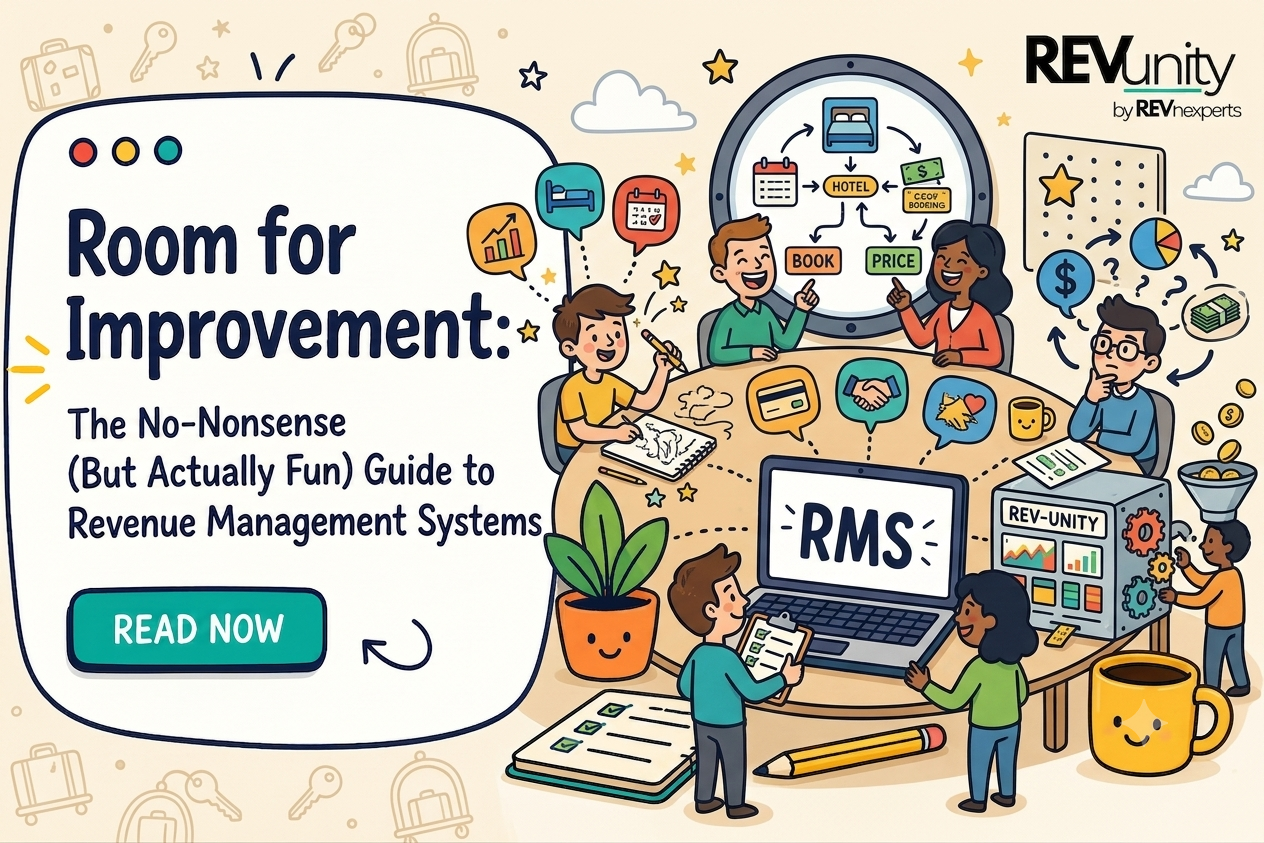
First things first: what even is an RMS?
Strip away the buzzwords and a Revenue Management System is software with one job: figure out the right price to sell a room at, at the right time, to the right guest, through the right channel.
That's it. Every dashboard, algorithm, and forecast graph exists to answer one recurring question, for every room type, every night on the calendar: what should this room cost tonight?
Before RMS software existed, revenue managers answered that question with spreadsheets, caffeine, and a lot of manual rate-shopping. It worked until it didn't. The moment you're juggling multiple room types, multiple channels, and rates that need to move by the hour, manual pricing simply can't keep up with how fast demand shifts today.
What's actually happening inside the black box
Every RMS, from the scrappy startup tool to the enterprise beast, runs roughly the same loop:
1. It hoovers up data. Historical bookings from your PMS, current pace and pickup, competitor rates, demand signals, local events, weather, even flight data.
2. It forecasts demand. How many rooms will sell at which price points, for each future date, based on patterns it's learned.
3. It recommends (or auto-sets) prices. Some systems nudge rates every few minutes. Others update once a day. Either way, this is the moment the math becomes a number on a screen.
4. It manages inventory, not just price. Length-of-stay restrictions, room-type availability, overbooking strategy all in service of protecting high-value bookings during high-demand periods.
5. It learns. The system checks what actually happened against what it predicted, and gets a little smarter next time.
Revenue managers who understand this loop know exactly when to trust the recommendation and when to override it. Revenue managers who don't tend to either blindly follow the machine or fight it on instinct both of which leave money on the table.
RMS, PMS, channel manager: stop mixing these up
This trips up almost everyone early on, so let's settle it for good:
● PMS (Property Management System) - Runs the hotel day-to-day: reservations, check-in/out, housekeeping, billing.
● Channel Manager - Blasts your rates and availability out to OTAs, GDS, and your own website at once.
● RMS (Revenue Management System) - Decides what those rates should be in the first place.
Some platforms now bundle all three. Others are standalone specialists that plug into whatever PMS and channel manager you're already running. Both approaches are valid more on that below.
Rules-based vs. AI-based: pick your fighter
Two broad flavors of RMS logic exist:
● Rules-based - You set the logic ("if occupancy hits 80%, raise the rate 10%"). Transparent and predictable, but needs constant manual upkeep as the market shifts.
● AI/analytics-based - Machine learning forecasts demand and sets prices with minimal manual rule-writing. More adaptive, but can feel like a black box if you don't understand what's driving it.
Most modern tools blend both: smart automation with a manual override layer, because no revenue manager wants to hand over 100% control without a safety net.
Okay, but why does this actually matter right now?
Fair question. A few things have shifted recently that make understanding your RMS less optional than it used to be.
Spreadsheets genuinely can't keep up anymore. Revenue management technology has evolved a lot since the 1980s, and modern systems can analyze real-time data and forecast demand in ways that make manual, spreadsheet-based pricing look almost prehistoric by comparison.
The market is quietly consolidating around integration. A 2025 survey found that roughly three-quarters of hotel companies now use a PMS, and among hotels actively doing revenue management, most are pricing through PMS-integrated tools rather than a separate standalone RMS with only a shrinking minority still relying purely on spreadsheets. The draw is simplicity, tighter integration, and cost efficiency. Larger properties with genuinely complex pricing still tend to reach for dedicated, standalone RMS platforms with deeper forecasting muscle.
The upside is measurable, not theoretical. Dynamic, RMS-driven pricing has been shown to lift room revenue by as much as 35% in some cases. Individual vendors report similarly strong results clients seeing double-digit percentage jumps in both revenue and occupancy after switching from manual pricing. Results vary by property, obviously, but the direction is consistent: hotels without dynamic pricing are leaving real money on the table.
Automation is getting bolder - and more trusted. A few years ago, "autopilot" pricing made a lot of revenue managers nervous. That's fading. Some platforms now update rates every 10 minutes instead of once a day, which matters most for properties without a full-time revenue manager on staff. The point isn't to replace your judgment it's to kill the manual grunt work so your judgment goes toward strategy instead of constant rate-checking.
So which tool should you actually use?
Here's the part everyone wants to skip to, and the part where I'll gently tell you there's no universal "best" answer. But here's how the landscape roughly breaks down:
Enterprise-grade (large hotels, groups, complex pricing)
● Duetto - Famous for "Open Pricing," letting hotels price room types and segments independently instead of being boxed in by traditional rate fencing.
● IDeaS - Heavyweight analytics, strong room-type-level forecasting, a favorite for teams that want deep data insight.
● Atomize (now part of Mews) - Built for automation, rates updating as often as every 10 minutes.
● FLYR Hospitality - Automates pricing, inventory, and group strategy with hourly updates driven by live PMS data and local events.
Mid-market (smarter pricing, less complexity)
● RoomPriceGenie - Fast to implement, easy to understand, built with independents in mind.
● Lighthouse - Market insight and business intelligence layered with pricing tools.
- PriceLabs - Blends automation with human control, popular for larger vacation rental portfolios.
Small hotel & boutique-friendly
● RoomPriceGenie and Little Hotelier - Automated recommendations without a steep learning curve.
● Smartpricing - AI-driven, minimal manual input required.
● Pricepoint - Real-time optimization with mobile oversight.
PMS with revenue tools baked in
● Mews- Dynamic pricing and demand forecasting built directly into the PMS.
● Cloudbeds - PMS, channel management, and booking engine bundled with built-in pricing analytics.
A dead-simple framework for choosing
Skip the "which brand is best" debate and ask your team these instead:
1. How complex is your pricing today? Multiple room categories and channels needing independent logic → lean enterprise RMS. Simple, single-rate pricing → you may not need a standalone tool at all.
2. Does your current PMS already have revenue tools? Prove it's genuinely insufficient before bolting on a second system.
3. How much manual oversight do you actually want? Full automation suits lean teams without a dedicated revenue manager. Rules-based or hybrid setups suit teams that want a tighter grip on strategy.
4. What's your property size and portfolio? Enterprise tools are built for scale. Tools like RoomPriceGenie and Smartpricing are built for independents.
The real takeaway
An RMS isn't magic, and it isn't just a fancy spreadsheet either — it's a forecasting engine wearing a pricing hat. The revenue managers who get the most out of theirs are the ones who understand why it's recommending a number, not just the ones who click "approve" the fastest.
Know the loop. Know your category. Then go pick a tool that actually fits — not just the one everyone's talking about.