
Why does the hotel tech stack matter for revenue?
Pricing strategy is only as good as the systems that carry it out. A perfect rate decision is worthless if it reaches one channel an hour late or never reaches the website at all. Understanding how your tools connect helps you ask better questions of vendors, spot problems earlier and protect revenue.
How the systems fit together: the data flow
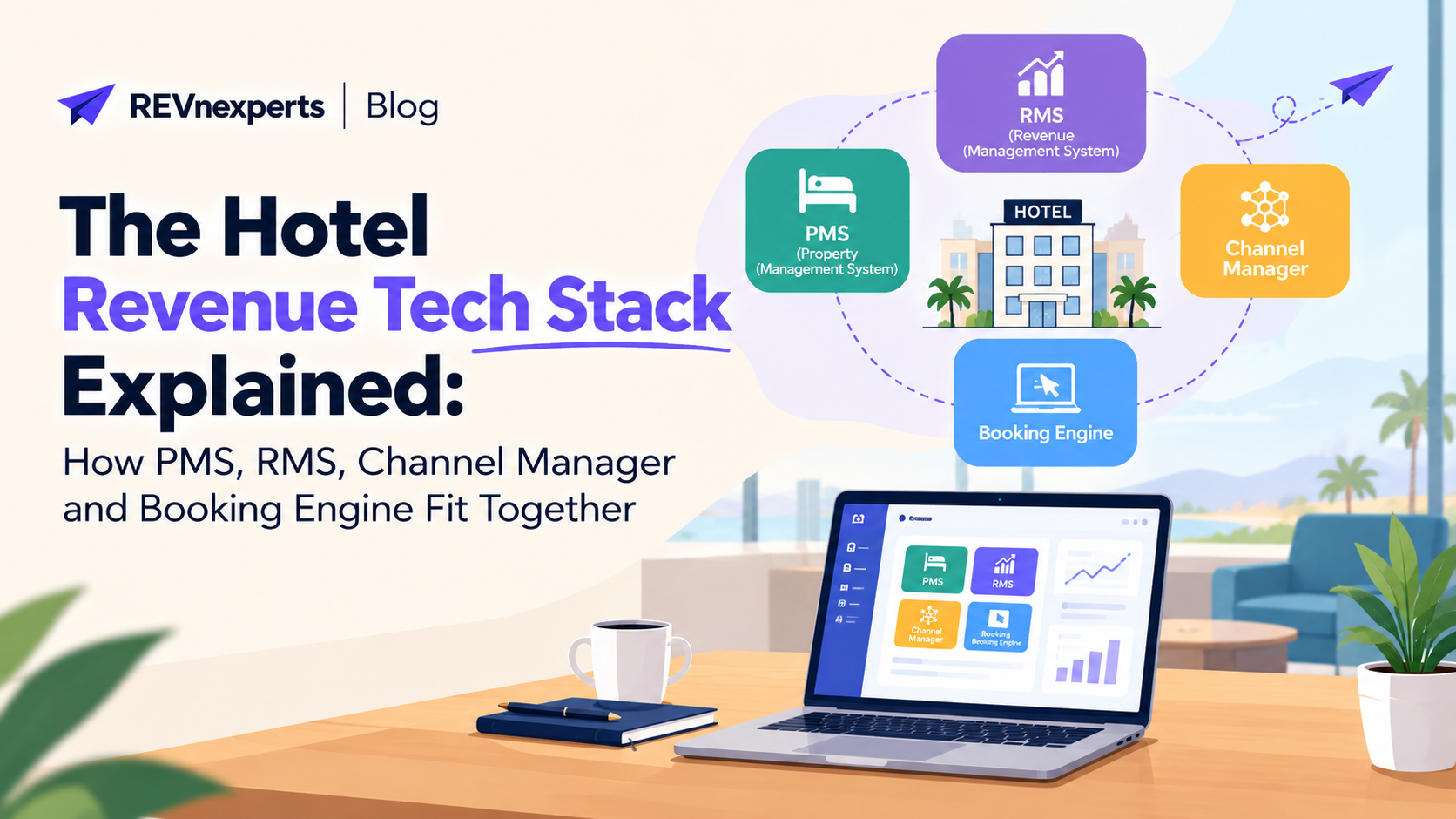
Here is the simplest way to picture it. Reservations and room status live in the PMS. Pricing intelligence sits in the RMS. Distribution runs through the channel manager. The booking engine captures direct demand.
  GUEST BOOKINGS (OTAs, website, phone, walk-in)
            |
            v
  +------------------+     rate and restriction     +--------------+
  |       PMS        | <--------------------------> |     RMS      |
  |  reservations,   |   demand data goes up,       |  forecasts,  |
  |  inventory,      |   price recommendations      |  pricing     |
  |  room status     |   come back                 +--------------+
  +------------------+
        ^        |
        |        v
  +------------------+       +-------------------+
  |  Channel manager | ----> |  OTAs, GDS,       |
  |  rates, inventory| <---- |  wholesalers      |
  +------------------+       +-------------------+
        ^        |
        |        v
  +------------------+
  |  Booking engine  |  <--- your hotel website, Google, metasearch
  +------------------+
In many modern setups some of these functions are bundled in one product, and some hotels use a central reservation system (CRS) in addition. The roles stay the same even when the product names change.
The four core systems in plain English
1. PMS (property management system)
What it does: Holds reservations, guest profiles, room inventory and room status. Handles check-in, check-out and billing.
Why revenue teams care: It is the source of truth for what you actually sold and what is left. Bad PMS data means bad forecasts and bad prices.
2. RMS (revenue management system)
What it does: Analyses historical and on-the-books data, demand patterns and market signals to forecast demand and recommend rates and restrictions.
Why revenue teams care: It speeds up daily pricing and reveals patterns that are hard to see by eye. It still needs a human who understands the market, events and strategy.
3. Channel manager
What it does: Sends rates, availability and restrictions to OTAs and other distribution partners, and brings reservations back into the PMS.
Why revenue teams care: It keeps inventory consistent across channels, which protects you from overbookings and rate disparity.
4. Booking engine
What it does: Lets guests book directly on your website, with rooms, rates, packages and payment.
Why revenue teams care: It is your most profitable channel when it converts well. A clunky or out-of-sync booking engine sends guests to OTAs.
PMS vs RMS: what is the difference?
The PMS records what has happened and what is booked. The RMS uses that data to decide what to charge next. A PMS without an RMS can work, but pricing relies on manual analysis. An RMS without clean PMS data produces poor recommendations.
Channel manager vs booking engine: what is the difference?
A channel manager distributes your inventory outward to third-party sites. A booking engine collects bookings on your own website. Both depend on the same rates and inventory, but one pushes to other people's platforms and the other powers your own. Most hotels need both.
Common integration gaps that quietly cost revenue
These are the problems revenue teams meet most often. Run through this list with your vendors and your team.
- Delayed rate or availability updates. If changes take too long to reach channels, you can sell rooms at outdated prices or oversell.
- Room type and rate plan mismatches. If a room type is named or mapped differently across systems, rates land on the wrong product.
- Restrictions that do not travel. Minimum stay, closed-to-arrival and similar rules set in one system may not reach every channel.
- Manual steps between RMS and PMS. If someone uploads RMS recommendations by hand, prices go stale and errors creep in.
- Booking engine missing packages or promotions. Direct guests see a weaker offer than OTA guests, which pushes them away.
- Reporting that does not reconcile. If systems define a booking, a cancellation or a segment differently, forecasts and reports disagree.
- Limited testing after updates. Software changes can break connections without anyone noticing.
Where to apply it: Pick one rate change and track it from the RMS through the PMS and channel manager to the booking engine. Note how long it takes and whether it shows up the same everywhere. That one test often reveals the weakest link.
Questions to ask before you add or change a system
- Which systems does it connect to natively, and which need a third-party connector?
- How quickly do rate and availability changes reach each channel?
- Who owns support when two vendors point at each other?
- What reports can I export, and in what format?
- What happens to data if I switch vendors later?
Which system should a small or independent hotel start with?
Most hotels begin with a PMS, a channel manager and a booking engine, since these cover operations and distribution. An RMS is a natural next step when the property has enough demand variation and complexity to justify automated pricing support. Start with your biggest revenue bottleneck, not with the longest feature list.
Frequently asked questions
What is a hotel tech stack?
It is the collection of connected software systems a hotel uses to operate and sell rooms, typically including a PMS, RMS, channel manager and booking engine, along with other tools such as a CRS, CRM and payment systems.
What is the difference between a PMS and an RMS?
A PMS manages reservations, guests and inventory. An RMS forecasts demand and recommends prices and restrictions using data from the PMS and the market.
What is the difference between a channel manager and a booking engine?
A channel manager sends rates and inventory to OTAs and other distribution partners. A booking engine takes direct bookings on the hotel's own website.
Do I need a revenue management system for a small hotel?
Not always. Small hotels can price manually with good data discipline. An RMS becomes more valuable as demand patterns, segments and channels grow more complex.
Can one vendor provide the whole stack?
Some vendors offer bundled products, others specialise. The best choice depends on your property, your team and how well the pieces integrate. Compare vendors on integration quality, support and data access, not only on features.
How do I know if my systems are integrated well?
Test a rate change across every system, compare channel prices against your master rates and check whether reports reconcile. Delays, mismatches and manual steps are warning signs.
Your next step
Want a deeper walkthrough of how hotel technology supports revenue decisions? Explore the REVnexperts Masterclass library for on-demand learning from practitioners. Browse the Masterclass library
Get the Revenue Expert Insider
One practical revenue idea in your inbox, every other week. No fluff.