
Career & Training
Building revenue capability in people, from classroom to commercial career.

Hotels Have L&D Budgets. But Are We Training for Business Performance?
Hotels are finally investing in their people again. 63% of hospitality businesses* report that they have increased their training budgets recently. On the surface, that’s a win. But if you look closer, many are falling into a "Service Trap."

Rewiring Revenue Education for the Tesla Era
An Ambassador car is a beautiful piece of history. It’s sturdy, reliable, and full of memories. But you wouldn't enter it into a Formula 1 race. So why is our revenue management education still running on a legacy engine while the industry has moved to a Tesla mindset? We’ve all seen it. A student spends years studying, scores an A+ in their Revenue Management paper, and then walks into their first job. But the moment they face a real-world dilemma, like a sudden drop in occupancy or a pricing war, they feel lost.
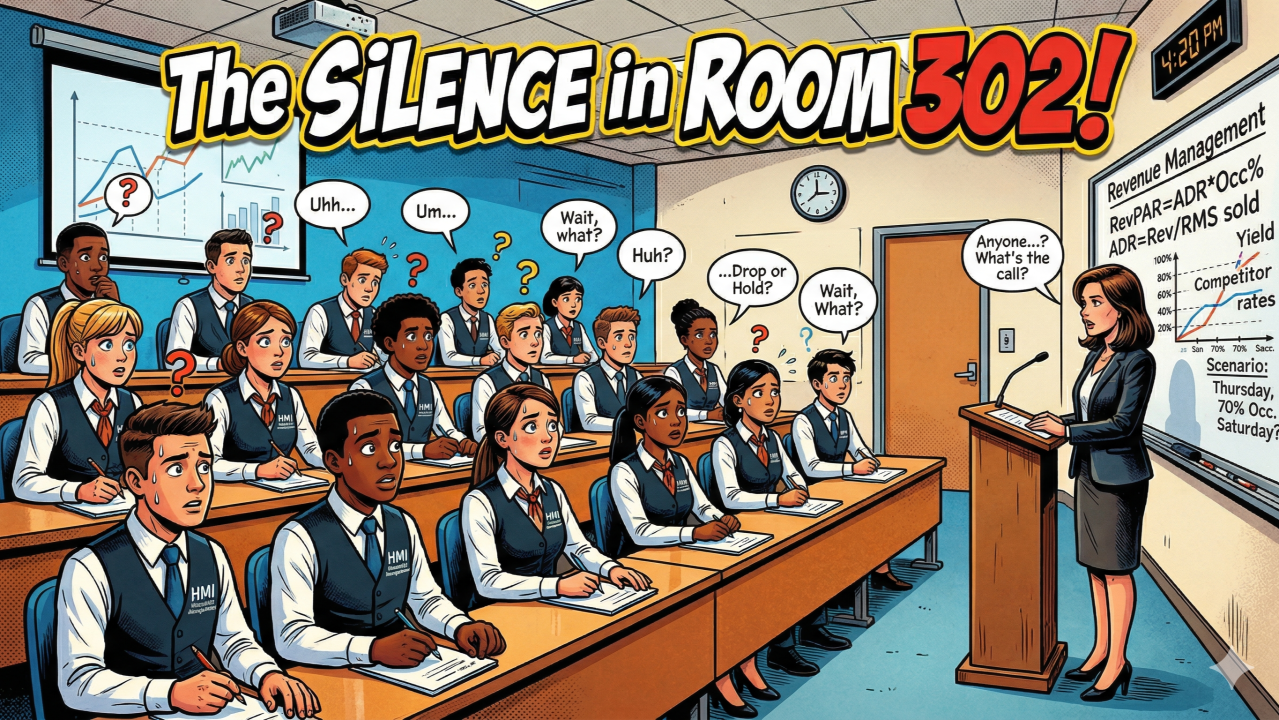
The Silence in Room 302
I often think of it like this: learning Revenue Management today is like reading a recipe. You know the ingredients, you know the steps, and you can explain the process. But standing in a live kitchen during peak hours, when things are going wrong and you have to make a split-second adjustment, is a completely different world. That is where decisions are made, and that is where learning actually becomes real. In Revenue Management, that "peak hour" moment is the daily reality. When students aren't trained for this, hotels pay the price. They spend months retraining new hires who often end up following competitors blindly or over-relying on automated systems because they don't understand the underlying logic. What should be a confident entry into a commercial career becomes a steep, expensive learning curve. So, the question is not whether Revenue Management is being taught, but how it is being built. We need a structured progression that moves from basic understanding to applied thinking to actual decision-making. Students shouldn't just learn what pricing is; they should be asked to price. They should be given situations where demand is unclear and data is messy, forced to choose a direction, and allowed to make mistakes in a safe environment.

AI stole my job! Or did it?
Rahul was a revenue executive, and he was great at it. Every morning, he would log into the property management system, armed with his coffee and confidence, ready to battle fluctuating demand, OTA rate disparities, and inventory adjustments. His job was to ensure that prices were optimized, availability was managed, and reports were ready for his manager.

Are Revenue Managers Really Managing Revenue… or Just Managing Systems?
Hi Revenue Readers! I met Anika (not her real name) last week at a gathering. She is a revenue manager at a well-known global hotel brand. I got really excited to meet her as I found her to be one of those rare, truly talented revenue professionals that are sharp, to the point, and completely in tune with what actually drives revenue. But I really felt bad for her (while I could fully relate to her myself) when she told me that instead of focusing on revenue strategy, she’s stuck fighting with technology and rigid processes every single day.